If you just received a letter from your lender, or someone mentioned the word “pre-foreclosure” and your stomach dropped, take a breath. You are not alone, and you are not out of options.
Every year, thousands of Florida homeowners find themselves in this exact moment. Scared. Confused. Unsure what comes next. Maybe you missed a few payments after a job loss, a health crisis, or a divorce. Maybe the cost of keeping up with your home after the last hurricane just got to be too much. Whatever brought you here, we want you to know one thing before you read another word: you still own your home, and you still have time.
This article is written for homeowners, not investors. We are going to explain exactly what pre-foreclosure means, how it works specifically in Florida, and what your real timeline looks like, in plain English, no legal jargon required. At Lincoln Madison Investments, we have helped hundreds of Polk County homeowners navigate this exact situation over the past 15 years. We know what this process looks like from the inside, and we are going to share that knowledge with you here.
Key Takeaways
- Pre-foreclosure is not foreclosure. It is the legal period after missed payments and before a court-ordered auction sale. You still own your home, and you still have options.
- Florida is a judicial foreclosure state. That means your lender cannot take your home without going through the court system, which gives you significantly more time than homeowners in non-judicial states typically have.
- The legal document filed in Florida is a lis pendens, not a Notice of Default. A lis pendens is a public court record attached to your property title, and understanding what it means is the first step to responding clearly.
- Federal law gives you a mandatory 120-day protection window before your lender can file a foreclosure lawsuit. That window is your strongest opportunity to explore every available option.
- Florida’s judicial foreclosure timeline typically runs 12 to 24 months or longer from the first missed payment to a final auction sale, depending on court backlog and whether the case is contested. Most national websites quote timelines that do not apply to Florida.
- Your equity does not disappear when you enter pre-foreclosure. What you owe the bank and what your home is worth are two separate numbers, and the gap between them may still be meaningful.
- The earlier you act, the more options you have. Homeowners who use the pre-foreclosure window to make informed decisions almost always come out in a better position than those who wait.
Pre-Foreclosure in Florida at a Glance
| Topic | What It Means in Florida |
|---|---|
| Definition | The period after a homeowner defaults on mortgage payments but before a court-ordered foreclosure sale |
| Trigger | Typically 3 or more missed payments, 90 or more days delinquent |
| Legal document filed | Lis pendens, filed in county court |
| Federal protection period | 120 days from first missed payment before lender can file a lawsuit |
| Pre-foreclosure period | Approximately 120 days from first missed payment to lis pendens filing |
| Active judicial process | 6 to 18 months from lis pendens filing to final judgment |
| Full timeline, first missed payment to auction | 10 to 24 months from first missed payment to auction sale |
| Who owns the home | The homeowner retains full legal title during pre-foreclosure |
| Can you sell during this time? | Yes, until the foreclosure auction is finalized |
| Is it public record? | Yes, the lis pendens is filed in county records and is publicly visible |
Define Pre Foreclosure
Pre-foreclosure is the legal stage between a homeowner’s first missed mortgage payment and a court-ordered foreclosure sale. During this period, the homeowner still owns and controls the property but is officially in default with their lender. It is not foreclosure yet. It is the warning period before foreclosure can happen.
What Is Pre Foreclosure In Florida?
In Florida, pre-foreclosure begins when a homeowner falls behind on mortgage payments, typically after 90 or more days of missed payments, and the lender initiates legal action. Florida is what is called a judicial foreclosure state. That means your lender cannot simply take your home. They have to file a lawsuit in court and go through a judge.
That legal requirement is actually a protection for you as a homeowner. It adds time and required process steps before anything can happen to your property. Per federal law under the Real Estate Settlement Procedures Act (RESPA), your lender cannot even begin the formal foreclosure process until you are at least 120 days behind on payments. That 120-day window is your federal protection period, and in Florida, the full judicial process typically adds many more months on top of that.
At Lincoln Madison Investments, we work with homeowners across Lakeland, Winter Haven, Davenport, and all of Polk County who are in exactly this stage. One of the first things we tell them is this: pre-foreclosure is not the end. It is the beginning of a window where you still have real choices.
What Is A Pre Foreclosure House?
A pre-foreclosure house is a property whose owner has defaulted on their mortgage and entered the pre-foreclosure stage, but the home has not been sold or auctioned yet. The homeowner still legally owns it. The bank does not own it. No sale has taken place.
What has happened is that the lender has started the legal clock. In Florida, that means a lis pendens, a formal legal notice, has been or will be filed in the county courthouse. The property is now in a legally sensitive position: the owner holds the title, but that title is under threat if the debt is not resolved.
This matters because it means the homeowner still has the legal right to sell the property, negotiate with the lender, or pursue another solution. That window closes only when a foreclosure sale is finalized by the court.
Pre Foreclosure Home Meaning
When you hear the phrase “pre-foreclosure home,” it means a home whose owner is behind on mortgage payments and the foreclosure process has begun, but the property has not yet been sold or auctioned. Think of it this way: foreclosure is the destination, and pre-foreclosure is the road that leads there. You can still take a different turn.
For the homeowner, this stage carries a heavy emotional weight. It can feel like a mark of failure, but here is the truth: this is something many families face, especially after life throws a curveball. A medical emergency. A job loss. A divorce. In Florida, events like hurricanes can push homeowners into financial distress practically overnight. These are not signs of failure. They are signs that life got hard.
What matters most right now is understanding exactly where you stand, because knowing your situation clearly is the first step toward making a decision that protects you, your family, and your future.
How Does Pre-Foreclosure Work in Florida?
Pre-foreclosure in Florida follows a specific legal sequence that is different from most other states. Because Florida is a judicial foreclosure state, every step has to go through the court system, which gives homeowners more time and more legal protections than they often realize.
Here is how the process unfolds from the moment you miss your first payment.
Day 1 to 30: First Missed Payment
Your payment is missed, the grace period ends, usually 10 to 15 days, and late fees are assessed. Your lender begins attempting to contact you by phone, letter, and notice. Nothing has been filed publicly yet. This is between you and your lender.
Day 30 to 60: Breach Letter
Your lender sends a breach letter, which is a formal private notice that you have violated the terms of your mortgage agreement, giving you 30 days to pay the full overdue amount and stop further action. This letter is not a public record and is not filed with any court. It is your lender’s warning shot before legal action begins.
Day 90 to 120: Notice of Intent to Foreclose
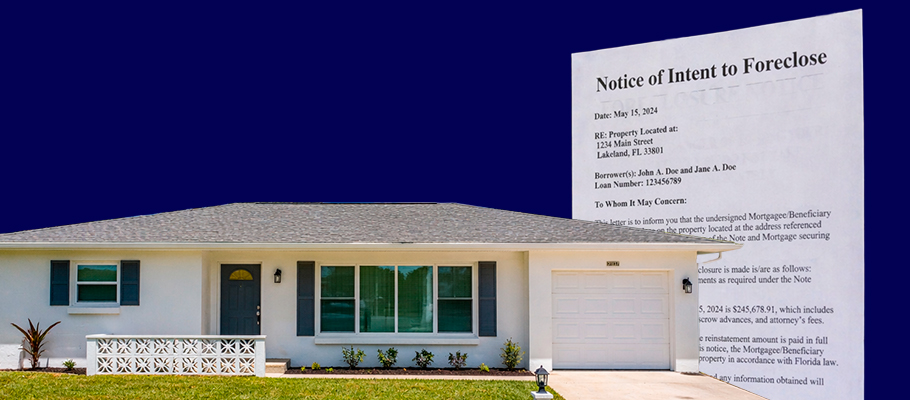
If you have not resolved the missed payments, the lender sends a notice of intent to foreclose. This is still a private communication, not a court filing. It is Florida’s equivalent of what other states call a Notice of Default, but unlike a Notice of Default used in non-judicial states like California, this notice is never recorded publicly in Florida. It simply signals that the lender is preparing to file a lawsuit.
Under federal law per the Real Estate Settlement Procedures Act (RESPA), which governs how mortgage servicers must handle delinquent loans, your lender cannot file a foreclosure lawsuit until you are at least 120 days past due. That mandatory window is your federal protection period.
Day 120 and Beyond: Lis Pendens Filed
If you have not cured the missed payments, the lender files a foreclosure lawsuit in your county’s circuit court and simultaneously records a lis pendens, Latin for “lawsuit pending,” which is a formal public notice that a legal claim has been filed against your property. Unlike the breach letter and notice of intent, the lis pendens is a public record. It attaches to your property title and is visible in county records, on real estate platforms like Zillow, and in foreclosure databases. This court filing is what officially marks the beginning of the active foreclosure process.
From Lis Pendens to Final Judgment: 6 to 18 Months
From this point, the case moves through the Florida court system. You will be served with legal papers and have 20 days to respond. The timeline depends on whether you respond to the lawsuit, whether a loan modification application, which is a formal request to restructure your mortgage terms, is pending, and how backed up your local court is.
The most important thing to remember at every stage: until the court enters a final judgment and the auction concludes with a winning bid accepted, you still own your home and you still have options.
Pre Foreclosure Lis Pendens
A pre-foreclosure lis pendens is a formal legal notice filed in the county courthouse at the same time your lender files a foreclosure lawsuit. In Latin, lis pendens means “lawsuit pending.” In plain English, it means the lender has gone to court and that lawsuit is now attached to your property’s public record.
Here is why that matters to you as a homeowner. Once a lis pendens is filed, anyone who searches your property title, whether a potential buyer, a title company, or another lender, will see it. It is a public record. It shows up in county records, on real estate platforms like Zillow, and in foreclosure databases.
A lot of homeowners feel a wave of panic when they find out their situation is now public. That is completely understandable. But here is what the lis pendens does not mean: it does not mean you have lost your home. It does not mean a sale date has been set. It is simply the legal marker that a lawsuit has been filed.
It is also important to know that Florida uses a lis pendens, not a Notice of Default. A Notice of Default is used in non-judicial foreclosure states like California. You may see that term on national websites, but it does not apply to Florida. If you are in Polk County or anywhere else in Florida, what you will see filed in your county records is a lis pendens. Understanding that distinction matters if you are reviewing documents or searching your own property records.
The 120-Day Federal Protection Window
Before your lender can file that lawsuit and lis pendens, federal law gives you a mandatory 120-day protection period. This rule comes from the Real Estate Settlement Procedures Act, commonly known as RESPA, and it applies in every state, including Florida.
What this means practically is that your lender must wait at least 120 days from your first missed payment before they can initiate any foreclosure action in court. During those 120 days, you have the legal right to explore every available option: catching up on payments, applying for a loan modification, requesting forbearance, or exploring a sale.
That is roughly four months where the door is legally required to stay open. Many homeowners do not know this, and some lenders do not go out of their way to explain it. At Lincoln Madison Investments, one of the first things our team does when a homeowner calls us in distress is walk them through exactly where they are in this timeline, because knowing how much time you actually have changes everything about how you approach your next decision.
Pre-Foreclosure vs. Foreclosure: What Is the Difference?
Pre-foreclosure and foreclosure are two different legal stages, and confusing one for the other can cause homeowners to either panic too early or wait too long. The single most important distinction: in pre-foreclosure you still own your home and can act. In foreclosure, the court has ruled and a sale has taken place.
Difference Between Pre Foreclosure And Foreclosure
Pre-foreclosure begins when the lender files the lawsuit and lis pendens. Foreclosure is finalized when the court enters a final judgment and the property is sold at auction. Everything that happens in between is still pre-foreclosure territory, and that window in Florida can last a very long time.
| Factor | Pre-Foreclosure | Foreclosure |
|---|---|---|
| Who owns the home | Homeowner retains legal title | Bank or new buyer after auction |
| Legal stage | Lawsuit filed, court judgment pending | Final judgment entered, auction completed |
| Can you sell the home? | Yes, until auction is finalized | No, title has transferred |
| Credit record | Missed payments reported to credit bureaus | Foreclosure recorded, stays 7 years |
| Public record | Lis pendens filed in county records | Final judgment and certificate of title recorded |
| Florida average duration | Approximately 120 days from first missed payment to lis pendens filing | 6 to 18 months from lis pendens filing to final judgment. Full timeline: 10 to 24 months from first missed payment to auction sale |
| Homeowner options | Sell, modify loan, catch up, short sale | Right of redemption ends at certificate of sale filing; once certificate of title issues, loss is final |
The table above shows why acting during pre-foreclosure matters so much. Once the gavel falls at auction and the certificate of title is issued to a new owner, your options are essentially gone. But right now, if you are in pre-foreclosure, that has not happened yet.
How Long Does Pre-Foreclosure Last in Florida?
In Florida, the pre-foreclosure period typically lasts approximately 120 days from the first missed payment until the lender files the lis pendens and foreclosure lawsuit. Once the lis pendens is filed, the active judicial process begins and can run an additional 6 to 18 months before a final judgment is entered. The full timeline from first missed payment to auction sale typically runs 10 to 24 months.
How Long Is The Pre Foreclosure Process?
In Florida, the pre-foreclosure process typically lasts 90 to 120 days from the first missed payment to the filing of the foreclosure lawsuit and lis pendens. Federal law requires lenders to wait a minimum of 120 days before filing, giving homeowners a mandatory window to explore alternatives like loan modifications or a sale. Once the lis pendens is filed, pre-foreclosure ends and the active judicial process begins.
| Stage | What Happens | Approximate Timeframe |
|---|---|---|
| First missed payment | Lender begins collection attempts | Day 1 |
| 30 to 60 days delinquent | Lender sends breach letter | Around Day 30 to 60 |
| 90 to 120 days delinquent | Lender sends notice of intent to foreclose | Around Day 90 to 120 |
| 120-day federal window closes | Lender can now file foreclosure lawsuit | Day 120 minimum |
| Lis pendens filed | Lawsuit and lis pendens recorded in county court, pre-foreclosure period ends | Day 120 or later |
| Homeowner served | Court summons delivered, 20 days to respond | Within days of filing |
| Court process | Contested or uncontested, hearings, mediation | 6 to 18 months |
| Final judgment | Judge rules in favor of lender | Varies widely |
| Foreclosure sale scheduled | Auction date set, typically 20 to 35 days out | After final judgment |
| Total from first missed payment | Full foreclosure timeline | 10 to 24 months |
Florida’s court system, particularly in counties like Polk, has historically experienced backlogs that push timelines further. A contested case, meaning one where the homeowner responds to the lawsuit and actively participates in the legal process, can take considerably longer than an uncontested one.
This is genuinely different from what most national articles tell you. If you read that pre-foreclosure lasts “three to six months,” that is not the Florida reality. The judicial process here is slower, and that extra time, as stressful as it feels, is actually time you can use to make a clear-headed decision about your home.
How Long Are Homes In Pre Foreclosure Before Sale?
Homes in Florida are in the pre-foreclosure period for approximately 120 days from the first missed payment until the lis pendens is filed. From that point, the active judicial process runs an additional 6 to 18 months before an auction sale takes place. The full timeline from first missed payment to auction sale typically runs 10 to 24 months. That range is wide because Florida’s judicial process moves at different speeds depending on the county, the court’s caseload, and how the homeowner responds to the lawsuit.
In Polk County specifically, court timelines can stretch longer than the state average due to caseload volume. That is not a bad thing for a homeowner who is actively using that time to explore their options. It is only a problem for homeowners who wait and do nothing.
Here is what that timeline looks like in context: a homeowner who misses their first payment in January may not see a foreclosure auction scheduled until late the following year, or even the year after that. The national websites that quote three to six months are describing non-judicial states. In Florida, the courts run the show, and courts take time.
What Factors Affect the Pre-Foreclosure Timeline in Florida?
The pre-foreclosure timeline in Florida is primarily affected by whether the homeowner responds to the lawsuit, whether a loan modification application is pending, the court’s caseload in the local county, and whether the lender pursues the case aggressively. These factors can compress or extend the active judicial process significantly, sometimes by several months.
| Factor | Effect on Timeline |
|---|---|
| Homeowner responds to lawsuit | Extends timeline, triggers hearings and mediation |
| Homeowner does not respond | Shortens timeline, lender can pursue default judgment faster |
| Loan modification application pending | RESPA rules pause foreclosure during active review |
| Court backlog in your county | Can add months to the process statewide |
| Bankruptcy filing | Triggers automatic stay, temporarily halts all foreclosure action |
| Property damage or title issues | Can complicate and delay the case |
| Lender’s legal resources | Well-resourced lenders move faster through the court process |
| Mediation required by court | Florida courts can order mediation, adding time |
One thing our agents at Lincoln Madison Investments consistently see in Polk County: homeowners who engage with the process, whether by responding to the lawsuit, applying for assistance, or contacting a cash buyer early, almost always have more time and more choices than homeowners who go quiet and hope the problem resolves itself. It never does.
What Happens to Your Equity During Pre-Foreclosure?
This is one of the most important questions homeowners ask, and almost no one answers it directly. Here is the honest answer: your equity does not disappear when you enter pre-foreclosure. What you owe the bank stays the same. What your home is worth is separate. The gap between those two numbers is your equity, and it may still be significant.
Let’s make this concrete. Say your Lakeland home is worth $260,000. You owe $190,000 on your mortgage. That is $70,000 in equity. Pre-foreclosure does not erase that. But here is what can erode it if you wait too long.
| Equity Risk During Pre-Foreclosure | How It Affects You |
|---|---|
| Attorney and court fees added to loan balance | Increases what you owe, shrinks equity |
| Property taxes going unpaid | Can result in a tax lien (legal claim for the unpaid tax debt) on top of the mortgage |
| Deferred maintenance and property deterioration | Reduces market value of the home |
| HOA fees and fines accumulating | Added as liens (legal claims) against the property |
| Foreclosure auction sale price | Auction sales often close below market value, reducing or eliminating equity recovery |
If your home goes all the way to a foreclosure auction, the bank is trying to recover what it is owed, not maximize what you walk away with. Any equity above that amount may or may not come back to you, depending on how the auction proceeds. In many cases, homeowners who had real equity left it on the table because they ran out of time.
Selling before the auction, on the other hand, gives you the opportunity to capture that equity. That is why acting early in the pre-foreclosure period matters so much financially, not just emotionally.
How Do You Know If Your Home Is in Pre-Foreclosure?
You can tell your home is in pre-foreclosure if you have missed three or more mortgage payments, received a breach letter or notice of intent to foreclose from your lender, been served with a court summons, or if a lis pendens has been filed against your property in the county courthouse records. Any one of these is a clear signal that the pre-foreclosure process has begun.
Here are the clearest signs that your home may be in pre-foreclosure in Florida.
- You have missed three or more mortgage payments and have not made a repayment arrangement with your lender.
- You received a notice of intent to foreclose from your lender or their attorney.
- You were served legal papers from a county circuit court. In Florida, this is the foreclosure lawsuit.
- A lis pendens has been filed against your property in the county courthouse records. You can search your county’s official records online to check this.
- Your home appears on Zillow or other real estate platforms with a pre-foreclosure label.
- You received contact from investors or cash buyers. Investors routinely monitor lis pendens filings in county records. If strangers are suddenly reaching out about buying your home, it is likely because your situation has become part of the public record.
If you want to check for yourself, Polk County property and court records are searchable through the Polk County Clerk of Courts website. You can search your name or property address to see if a lis pendens has been filed.
What Are Your Options in Pre-Foreclosure?
If you are in pre-foreclosure right now, you have more options than you probably think. This is not a one-road situation.
Here is a summary of what is available to most Florida homeowners at this stage.
- Catch up on missed payments. If you can bring the loan current, the foreclosure process stops. This is called “curing the default.”
- Request a loan modification. Your lender may be willing to restructure your loan, lower your interest rate, or extend your term to make payments manageable. Applying for a modification also pauses foreclosure action while it is under active review.
- Request forbearance. A temporary pause or reduction in payments while you get back on your feet.
- Sell your home before the auction. You can sell your home during pre-foreclosure, and depending on your equity, you may walk away with money in your pocket. This includes selling to a cash buyer, listing with an agent, or pursuing a short sale if you owe more than the home is worth.
- Pursue a deed-in-lieu of foreclosure. You voluntarily transfer the title back to the lender in exchange for them releasing the debt. Less damaging than a full foreclosure, but still has credit consequences.
Each of these options comes with its own timeline, trade-offs, and eligibility requirements.
Not sure which option fits your situation? At Lincoln Madison Investments, our agents are available seven days a week to walk you through your specific circumstances with no pressure and no obligation. We have helped homeowners across Lakeland, Winter Haven, Bartow, Haines City, and across all of Polk County find a clear path forward from exactly this stage.
Talk to a Polk County Expert Today, No Obligation Get a Free Cash Offer
What Does Pre Foreclosure Mean On Zillow?
When Zillow labels a property as “pre-foreclosure,” it means the platform has detected a lis pendens filing in the county’s public records, indicating the homeowner has defaulted on their mortgage and a foreclosure lawsuit has been filed. The home is not officially listed for sale. The owner still holds the title. Zillow is simply surfacing publicly available court data.
A few important things to know about Zillow’s pre-foreclosure data. First, it can be delayed. Zillow pulls from county records, and those records are not always updated in real time. A property may show as pre-foreclosure even if the homeowner has since resolved the situation. Second, if you see your own home listed as pre-foreclosure on Zillow and did not know about it, that is your cue to check your county court records immediately and take stock of where you actually stand.
If the Zillow listing shows an auction date rather than a pre-foreclosure label, that means the case has progressed further. A final judgment has likely been entered and a sale date has been scheduled. That is a narrower window, but in Florida, even a scheduled auction can sometimes be delayed. If you are at that stage, contact a local expert immediately.
FAQs About Pre-Foreclosure in Florida
Pre-foreclosure raises a lot of questions, and most of the answers depend heavily on where you live. Because Florida is a judicial foreclosure state with its own specific laws and timelines, some of the answers here will be different from what you find on national websites. Here are the most common questions we hear from Polk County homeowners.
Most Florida lenders begin the formal pre-foreclosure process after three or more missed payments, which is typically around 90 days of delinquency. However, under federal law, your lender cannot file a foreclosure lawsuit until you are at least 120 days past due on your first missed payment. Missing one or two payments is serious and you should contact your lender immediately, but it does not automatically trigger a lawsuit. The clock starts ticking loudest at that 90 to 120-day mark.
In Florida, pre-foreclosure begins when a homeowner falls 90 or more days behind on mortgage payments and the lender files a foreclosure lawsuit in county circuit court, along with a lis pendens against the property. Because Florida is a judicial state, the entire process must move through the court system. The homeowner is served with legal papers and has 20 days to respond. From that point, the case can take anywhere from 12 to 36 months to reach a final judgment and auction sale, depending on the court’s caseload and whether the homeowner contests the lawsuit.
For a homeowner, pre-foreclosure is a serious situation, but it is not a death sentence for your financial future. It is a warning period, and warning periods exist for a reason: to give you time to act. The pre-foreclosure stage itself is not what damages you. What damages you is letting it progress to a completed foreclosure without taking any action. Homeowners who use the pre-foreclosure window to explore their options, whether that is catching up on payments, modifying their loan, or selling the home, often come out in a far better position than those who wait. Think of pre-foreclosure as a loud alarm. It is uncomfortable, but it is telling you something important while you still have time to respond.
Pre-foreclosure itself does not appear as a single line item on your credit report, but the missed payments that triggered it do. Each missed mortgage payment is reported to the credit bureaus and will lower your credit score. The longer the delinquency goes on, the greater the credit impact. A completed foreclosure, on the other hand, is recorded directly on your credit report and can remain there for up to seven years. That is a significantly heavier mark than missed payments alone.
A pre-foreclosure sale is when a homeowner sells their property during the pre-foreclosure period, before the court finalizes a foreclosure judgment and the home goes to auction. The sale proceeds are used to pay off the outstanding mortgage balance. If the home sells for more than what is owed, the homeowner keeps the difference. If it sells for less than what is owed, that is called a short sale, which requires lender approval. A pre-foreclosure sale is generally the best financial outcome available to a homeowner in default because it protects equity, limits credit damage, and closes the foreclosure case.
When Zillow displays an auction label instead of a pre-foreclosure label, it means the case has moved past the lawsuit stage. A court has likely entered a final judgment in favor of the lender, and a foreclosure auction date has been officially scheduled. At this point, the window is significantly narrower, but in Florida, even scheduled auctions can sometimes be postponed due to legal challenges, bankruptcy filings, or lender agreements. If you see your home listed with an auction date on Zillow, do not assume it is over. Contact a local real estate expert in Polk County immediately to understand exactly where the case stands and what options, if any, remain.
Yes, pre-foreclosure can be stopped, but it requires action. There is no version of this where waiting and hoping produces a good outcome. Pre-foreclosure stops when the underlying debt problem is resolved, either by catching up on missed payments, completing a loan modification, selling the home, or reaching another agreement with the lender. In Florida, because the process moves through the courts, homeowners also have the option of contesting the lawsuit, which at minimum buys additional time. The earlier you act, the more options you have. The closer you get to a final judgment and auction date, the fewer doors remain open.
In Florida, a house can stay in pre-foreclosure for approximately 120 days from the first missed payment until the lender files the foreclosure lawsuit and lis pendens. However, if the lender delays filing, a loan modification application is pending, or the homeowner contests the lawsuit, the overall period before a final auction sale can extend to 10 to 24 months. Florida’s judicial process gives homeowners more time than most states, but that window is not indefinite.
Yes, pre-foreclosure can be resolved by curing the default, meaning bringing all missed payments current, applying for a loan modification to restructure the mortgage terms, or selling the home before the foreclosure auction takes place. Each option has different eligibility requirements and timelines.
Consulting a HUD-approved housing counselor or a Florida real estate attorney during pre-foreclosure is strongly recommended, particularly if you have been served with a foreclosure lawsuit. An attorney can review the lawsuit for procedural errors, represent you in court, and advise on loss mitigation options. A HUD-approved counselor can help you evaluate loan modification and forbearance options at no cost. Acting without professional guidance during an active court case increases the risk of missing critical deadlines that could have preserved your options.
Conclusion
Pre-foreclosure is not the end of the road. It is a legal stage with a defined timeline, specific rules, and real protections built in for Florida homeowners. You still own your home. You still have time. And you have more options than most people in your situation realize.
What matters most right now is not that you are in pre-foreclosure. What matters is what you do next.
If you are feeling overwhelmed, that is completely normal. This is a lot of information to absorb, especially when you are already dealing with financial stress, uncertainty, and maybe some fear about what comes next. But here is what 15 years of working with Polk County homeowners has taught us at Lincoln Madison Investments: the families who come out of this in the best shape are the ones who asked for help early and made informed decisions. Not the ones who had the most money, or the perfect credit score, or a house in perfect condition.
Just the ones who did not wait.
Talk to a Local Expert Who Knows Polk County
At Lincoln Madison Investments, we are headquartered right here in Lakeland and have been buying homes across Polk County for over 15 years. We have purchased more than $100 million in real estate and worked with homeowners in every situation you can imagine, including pre-foreclosure, probate, code violations, hurricane damage, HOA disputes, and more.
We buy homes as-is, for cash, with no repairs required and no commissions. We can close quickly, which matters enormously when you are working against a foreclosure timeline. And our licensed agents are available seven days a week because we know these situations do not wait for business hours.
If you are in pre-foreclosure and want a no-pressure conversation about your options, we are here. No obligation. Just honest answers from people who know Polk County real estate inside and out.
Get a Free Cash Offer Today Talk to a Polk County Expert
References
All claims in this article that reference specific legal standards, federal rules, Florida statutes, or institutional data are sourced below.
- Consumer Financial Protection Bureau: 120-Day Rule Before Foreclosure (RESPA) https://www.consumerfinance.gov/rules-policy/final-rules/2013-mortgage-servicing-rules/
- Florida Statutes Chapter 702: Foreclosure of Mortgages and Statutory Liens https://www.flsenate.gov/Laws/Statutes/2023/Chapter702
- Florida Statutes Section 48.23: Lis Pendens https://www.flsenate.gov/Laws/Statutes/2023/48.23
- Polk County Clerk of Courts: Official Property and Court Records Search. https://www.polkcountyclerk.net/
- Consumer Financial Protection Bureau: Real Estate Settlement Procedures Act (RESPA) https://www.consumerfinance.gov/compliance/compliance-resources/mortgage-resources/real-estate-settlement-procedures-act/
- Federal Trade Commission: Fair Credit Reporting Act (FCRA) https://www.ftc.gov/legal-library/browse/statutes/fair-credit-reporting-act