Spring, particularly March through May, is often one of the best periods to sell a house in Florida, but there’s no single best month for every homeowner. The right timing depends on your local market, your property’s condition, buyer demand, and how long you can realistically afford to wait.
Thinking about listing your Florida home and wondering if you’re picking the right month? You’re not alone. Almost every homeowner asks the same question before they put up a sign: “Am I about to make a mistake by selling too early, or waiting too long?” Your home can be one of your biggest investments, so it’s reasonable to be cautious. By the end of this guide, you’ll know how to weigh all of it, so you can decide with confidence whether now’s your moment, or if waiting actually makes sense for you.
Key Takeaways
Here’s what matters most from this guide:
- Spring sells strongest, but depending on where your home is located, the exact peak window changes: Florida Realtors data shows Jacksonville’s strongest week arriving as early as March 22, 2026, while Orlando and Tampa peak the week of April 19, and Miami-Fort Lauderdale-West Palm Beach peaks later still, the week of May 24.
- Waiting has a real cost: Every month you hold onto a property means another mortgage payment, insurance bill, and upkeep expense, whether you’re living in it or not.
- Waiting doesn’t guarantee your home is worth more later: Long-term appreciation and short-term seasonal timing are two different things, and in a flat or buyer-leaning market, the math doesn’t always favor holding out.
- Timing isn’t the only thing that affects your sale: Hurricane season, your roof’s insurability, mortgage rates, and your home’s condition can all matter as much as, or more than, which month you list.
- Your situation matters more than the calendar: A hard deadline, an inherited property, or a home that needs work can make “right now” the smarter choice, no matter the season.
Best Time to Sell a House in Florida Overview
| METRIC | FIGURE |
|---|---|
| Strongest Florida listing windows (2026) | Range from March 22 (Jacksonville) to May 24 (Miami-Fort Lauderdale-West Palm Beach), with Tampa and Orlando-Kissimmee-Sanford both peaking April 19 |
| Strongest national listing window (2026) | Week of April 12-18, 2026 |
| Highest historical national seller premium month, 2015-2025 (closing price vs. estimated value) | March, 10.7% |
| Second-highest premium months, 2015-2025 | April and May, 10.2% each |
| Lowest premium months, 2015-2025 | October (7.9%) and September (8.0%) |
What Time of Year Is Best to Sell a House
Spring, particularly March through May, generally brings the strongest buyer activity and best prices for selling a house in Florida. Winter can also work well, especially in coastal markets with seasonal buyers. Summer and fall typically see less competition among buyers, though hurricane season can add scheduling challenges from June through November.
Each season has its own personality here. Let’s walk through what you can expect month by month.
Why Is Spring the Best Time to Sell a House?
Spring tends to bring more buyers, better weather for showings, and often the strongest prices of the year. In Florida, this window usually runs from March through May, right as families start planning summer moves before the new school year.
Here’s why it works so well. Buyers are out in force after a slower winter. Your yard is green, the flowers are blooming, and the beautiful Florida spring weather really shows through your home’s listing photographs. Spring’s longer daylight hours also give you more flexibility for evening and weekend showings.
Here’s where it gets specific to your part of the state. Florida Realtors, citing Realtor.com’s Best Time to Sell report, found that the strongest listing week varies across Florida’s major metros in 2026.
| Florida Metro | Best Week to List | Potential Listing Price Increase | Approx. Dollar Increase |
|---|---|---|---|
| Jacksonville | Week of March 22 | 5.3% | $20,000 |
| Tampa | Week of April 19 | 6.2% | $25,000 |
| Orlando | Week of April 19 | 5.0% | $21,000 |
| Miami-Fort Lauderdale-West Palm Beach | Week of May 24 | 5.1% | $26,000 |
The pattern is pretty clear: spring tends to work in a seller’s favor, but the best week depends on your local market. Jacksonville’s opportunity comes first in late March, Tampa and Orlando peak in April, and South Florida’s strongest week arrives later in May.
So, if you’re trying to time your sale, don’t rely on one “best month” for the entire state. The week worth circling on your calendar can look very different depending on where your Florida home is located.
Looking at the broader market, ATTOM reviewed more than 52 million home sales across the country from 2015 through 2025. March came out on top, with sellers getting an average 10.7% premium. May and April were close behind at 10.2%.
Can Winter Be a Good Time to Sell a House in Florida?
Yes, winter can absolutely work in your favor, especially in Florida. While much of the country is buried in snow, Florida’s weather stays mild, which draws serious buyers looking to relocate or buy a second home.
Winter buyers are often serious about making a move. Some are retirees or remote workers coming to Florida from colder states, and many already have their financing in place or have sold their previous home. This tends to be more noticeable in South Florida and coastal markets, though, so the effect may be less pronounced in Polk County.
Is Summer a Good Time to Sell a House in Florida?
Summer can be a solid choice too, particularly for families who want to move before the new school year starts. It’s also when Florida’s heat and afternoon storms start to test buyer patience a little.
Think about it this way: a Florida family with kids heading into third grade wants to be settled in before August. That urgency can work in your favor as a seller! On the flip side, summer showings mean more sweat, more humidity, and buyers who are a bit more selective since they’re not rushing against the same spring competition. Pricing and presentation matter even more when the temperature climbs.
Is Fall a Good Time to Sell a House?
Fall isn’t the strongest season, and historical data shows it’s not the best time to sell a house in Florida. Buyer traffic slows down somewhat as summer ends, though serious buyers are often still shopping, especially those who missed out during the spring rush.
Slower buyer traffic does have one upside: you’ll also see less competition from other sellers, which can work in your favor if your home is priced right and shows well. It’s a smaller pool on both sides, not a strong pool for you.
Is September a Good Time to Sell a House
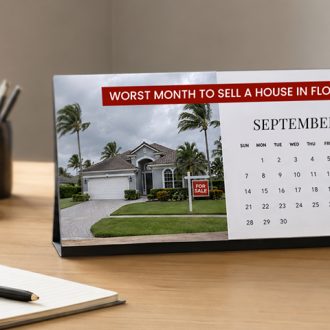
September is historically one of Florida’s slower months to sell. It’s the peak of hurricane season, with NOAA data showing storm activity typically cresting around September 10, and that timing affects more than showings, it can delay the steps that get you to closing.
Here’s what that looks like in practice. A storm or hurricane can push back a scheduled inspection, delay an insurance binder your buyer needs to close, or stall an appraisal if an appraiser can’t safely get to the property. Homes still sell in September, but slower and with more friction than in stronger months, so if you’re listing during this window, build in extra time on your closing timeline rather than expecting it to move at spring’s pace.
Best Month to Sell a House in Florida
In Florida, the best month to sell depends on your metro: Jacksonville peaks in late March, Tampa and Orlando-Kissimmee-Sanford in mid-April, and Miami-Fort Lauderdale-West Palm Beach in late May, each metro’s own listing data points to a different peak week. Nationally, March leads at a 10.7% seller premium, just ahead of April and May at 10.2% each.
Once you’ve settled on a season, the next question is picking an actual month, and whether the month you list in is even the month you’ll close. Here’s how March, April, and May compare, and why timing your listing isn’t quite the same as timing your closing.
March, April or May: Which Month Should You Choose?
The honest answer: for most Florida sellers, this isn’t really a three-way national choice. Work backward from your own metro’s peak week instead, covered above, since where you’re selling matters more than which of these three months wins nationally by half a percentage point.
If you’re in the Jacksonville area, that likely means listing in March. If you’re closer to Tampa, Orlando-Kissimmee-Sanford, or Polk County, April is probably your window. If you’re in South Florida, May may serve you better. The exact national ranking is in the summary table near the top of this guide if you want to see it again, but your local timing should carry more weight than that ranking does.
Buyer interest usually starts picking up before the market reaches its busiest week. That is why you should try listing two or three weeks ahead of the window you are aiming for. It gives your home time to get noticed and build interest before buyer activity is at its strongest.
If your city isn’t one of the four we named here, you’re not without a data point. These four simply have published metro-specific 2026 listing data available; most of Florida doesn’t have that level of detail broken out. What does apply statewide is the seasonal pattern itself: ATTOM’s national analysis found March, April, and May consistently deliver the strongest seller premiums, 10.7% and 10.2% respectively, and that spring pattern generally holds true across Florida’s markets even where metro-level dates haven’t been published. Aiming for a listing sometime in that March-to-May window is a reasonable, data-backed starting point no matter where in Florida you’re selling.
Best Month to List vs. Best Month to Close
The best month to list isn’t the best month to close. Listing during a strong window like April, when Tampa and Orlando-Kissimmee-Sanford both see their peak buyer activity, gets you buyer competition and pricing leverage at the offer stage, but your closing date, when the sale actually finalizes, is a separate clock. Nationally, ICE Mortgage Technology reported purchase loans closing in an average of 36.8 days in March 2026, the fastest pace since ICE began tracking this metric. A cash sale skips mortgage underwriting entirely, so it can close in as little as 7 to 14 days.
That timing can make a big difference if you need to sell because of a new out-of-state job, or if you need to sell an inherited home you do not want to keep paying for.
If you have a deadline, start with the date you need to close and work backward. Factor in how long the sale and closing may take, then use that to decide when the home should go on the market.
Does the Best Time to Sell Depend on Where You Live in Florida
Yes. Florida isn’t one housing market; it’s dozens of smaller ones, each moving at its own pace with its own inventory and buyer demand. A strong month in Miami can look completely different from a strong month in Jacksonville or Lakeland, which is why local data matters more than statewide or national averages once you’re actually deciding when to sell.
Here’s what that looks like close to home.
Central Florida and Polk County
Polk County sits geographically between the Orlando and Tampa markets, but it doesn’t simply borrow their timing; it moves at its own pace. Here’s what the most current local numbers show.
| Metric | Figure |
|---|---|
| Polk County months of supply | 4.71, June 2026 |
| Lakeland median days on market | 63 days, June 2026 |
A months-of-supply number in that range means buyers currently have more homes to choose from, which tends to favor buyers over sellers, a different picture than the spring listing surges we just covered in Orlando and Tampa. It doesn’t mean homes aren’t selling here; they are, but it does mean pricing, presentation, and patience matter more locally than the statewide spring narrative alone would suggest.
The 63-day figure tells you something important about the Lakeland market. That is the median time it takes for a home to go from being listed to under contract. In a strong seller’s market, a well-priced home may find a buyer in just two or three weeks.
When the typical timeline stretches closer to two months, buyers usually have more room to shop around. Homes that are priced too high or need noticeable repairs may take even longer to sell.
Here’s why that matters for timing your sale: in a market like this, waiting for “the best month” matters less than getting your pricing and presentation right from day one. A well-prepared listing in a so-so month can outperform a poorly priced one in a great month, especially with 4.71 months of supply giving buyers plenty of other options to compare yours against.
When Is a Good Time to Sell a House
A good time to sell is when your local market conditions, your home’s readiness to list, and your own timeline all line up, not simply when the calendar says spring. In practice, that means checking current local inventory and demand, making sure your home is priced and presented well, and confirming the timing works for your own situation before listing.
What “good” means also depends heavily on what you’re personally trying to accomplish.
What Does “Best Time” Mean for You?
“Best time to sell” means something different depending on what you’re optimizing for. A seller chasing top dollar and a seller who needs to move in three weeks are answering two different questions, even if they’re both asking about “the best time.”
| Your Priority | What “Best Time” Actually Means |
|---|---|
| Maximum sale price | A period with strong buyer demand and favorable negotiating conditions |
| Selling quickly | Whatever period or approach most reliably shortens your time on market |
| Family or work timeline | Timing built around school, a job start date, or another fixed deadline |
| Lower carrying costs | Sooner rather than later, since every extra month adds mortgage, insurance, and upkeep costs |
| Less stress | A realistic, workable timeline instead of trying to perfectly time the market |
Once you know which of these matters most to you, the rest of this guide gets a lot easier to apply. A homeowner optimizing for price reads the market data differently than one optimizing for speed or peace of mind.
Is It a Good Time to Sell a House in Florida Right Now
The honest answer changes by the month, so instead of a fixed yes or no, here’s what to actually check:
- current inventory levels
- median days on market
- prices rising or falling in your area
Below is the most recent statewide snapshot we have, plus how to read it.
Florida Market Snapshot
| Metric | Figure |
|---|---|
| Single-family closed sales, year over year | Up just over 5% |
| Consecutive months of year-over-year sales growth | 11 |
| Statewide median closed price (single-family) | $425,000, up 3.7% year over year |
| Statewide single-family inventory, year over year | Down almost 13.5% |
| Statewide median listing price (single-family + condo/townhome) | $419,000, down 3.68% year over year |
| Share of listings with a price cut | Nearly 1 in 5 |
Two things are worth understanding about this table before you read too much into it. First, the closed-price and listing-price figures aren’t measuring the same properties, one covers single-family homes only, the other includes condos and townhomes too, so don’t expect them to match exactly. Second, and more importantly, these numbers describe the state as a whole. Florida Realtors’ own analysts are quick to point out that statewide numbers only tell part of the story, and your specific market may look very different from the state’s average.
We already looked at what Polk County’s own numbers show earlier in this guide. A statewide “good time to sell” doesn’t automatically apply to every local market, including ours, which is exactly why checking your own local data matters more than any statewide headline, whenever you happen to be reading this.
Should You Wait for a Better Time to Sell Your House
For most Florida homeowners, waiting only makes sense if the potential upside clearly outweighs what it costs you to keep the property in the meantime, and that’s rarely as obvious as it feels. The questions and math below will help you figure out which side of that line you’re actually on.
Ask Yourself These 6 Questions Before You Wait To Sell Your House
Before you decide to wait, take a minute to think through these six questions. Your answers may tell you more about the right time to sell than any seasonal market chart.
- What would waiting actually cost you, in real dollars? We’ll do the exact math in the next section, this is just the gut-check before you see the number.
- Is your home already in sellable condition, or would it need work either way? If repairs are coming regardless of when you sell, waiting doesn’t solve that problem; it just postpones it.
- Is there a deadline driving this, or just a preference? A hard deadline changes the math completely. A soft preference for “a better time” is worth examining more critically.
- What specifically are you waiting for? A particular price, a certain buyer, a better season, “things to feel more settled”? If you can’t name it clearly, you may be avoiding the decision more than timing it.
- What’s actually driving the urge to wait? Sometimes it’s a legitimate strategy. Sometimes it’s hesitation about a big decision dressed up as market timing.
- If nothing changed in six months, would you regret not selling now? This one cuts through a lot of the noise the other five raise.
What is the Cost of Waiting to Sell a House in Florida?
A simple way to see what waiting could cost is to put the numbers on paper. Add your monthly mortgage payment, plus any property taxes, insurance, and upkeep that are not already included in escrow. Then multiply that total by the number of months you are thinking about waiting.
Calculate the Cost of Waiting
Example: a $325,000 Polk County home
| Monthly Cash Outflow | Amount |
|---|---|
| Mortgage payment (principal, interest, taxes and insurance in escrow) | $2,100 |
| Basic upkeep (lawn care, pest control, minor repairs) | $175 |
| Total monthly cash outflow | $2,275 |
| Cost of waiting 4 months | $9,100 |
That $9,100 needs to be weighed against whatever benefit you actually expect from waiting, a stronger listing week, a hoped-for price increase, or simply not feeling rushed. Worth remembering too: part of your mortgage payment is building equity, not disappearing, so your actual loss from waiting is somewhat less than this total, though the cash still has to come from somewhere each month. Sometimes that trade genuinely makes sense. Often, once it’s written down in real dollars, it doesn’t.
Ready to See What Selling Now Actually Looks Like?
If that number changed how waiting feels, you’re not alone. A lot of homeowners run this same math and realize the calendar isn’t really working in their favor. If this is your case, don’t wait. Get a no-obligation cash offer from Lincoln Madison Investments and skip the months of carrying costs entirely. We buy homes as-is, close in as little as 7 to 14 days, and handle the details so you don’t have to keep paying to wait.
When Waiting To Sell a House May Make Sense
Waiting to sell can be the better choice when you have a clear reason to believe your situation will improve. The key is that you are waiting for something specific, not simply hoping the market gets better.
Here are a few situations where holding off may make sense:
You need time to make repairs that could improve the sale.
Waiting can make sense if planned repairs could help your home show better, qualify for insurance, or attract stronger offers.
You are very close to reaching an important financial milestone.
A short delay may be worthwhile if it helps you pay down debt, meet a tax-related requirement, get a job promotion, or reach another financial goal.
You don’t want to give up a low mortgage rate.
If you have a much lower rate than what is currently available, moving could mean taking on a significantly higher monthly payment.
You’re worried you won’t find an affordable replacement home.
Selling may not make sense yet if current home prices, mortgage rates, insurance, or taxes would make your next home too expensive.
You do not have a good housing option lined up yet.
Waiting can give you more time to find your next home and avoid feeling rushed into a move that does not fit your needs.
You have the luxury of time and can comfortably afford to wait for a stronger selling season or a seller’s market.
If carrying costs are manageable and you are not under pressure to sell, waiting for more favorable conditions may be a reasonable option.
The main thing is to know why you’re waiting and what you expect to be different at the end of that wait. Maybe a repair will be finished, your finances will improve, or you’re aiming for a specific selling window.
Just make sure you have a clear end date and know what those extra weeks or months will cost. If nothing is really going to change, waiting may not be helping you much.
When Selling a House Now May Make More Sense
Selling now tends to make more sense when carrying costs are eating into what you’d actually gain by waiting, or when your situation includes a deadline the calendar can’t accommodate.
Your carrying costs are adding up quickly.
Mortgage payments, insurance, property taxes, utilities, and maintenance can eat into what you might gain by waiting for a better market.
The property is vacant.
An empty home still costs money every month, and it may also require extra maintenance, security, and insurance while you wait.
You inherited a property you do not want to keep.
If an inherited home is creating ongoing expenses or responsibilities, selling the probate property sooner may be the simpler option.
You are behind on mortgage payments.
Waiting can become risky when missed payments continue to add up and the foreclosure process is already moving forward.
You are facing foreclosure.
If time is limited, trying to sell before foreclosure may matter more than waiting for a traditionally stronger selling month.
You need to sell within a specific timeframe.
A job relocation, divorce, estate deadline, financial hardship, or another major life change may make speed more important than perfect market timing.
In these situations, selling your home fast for cash can be worth considering, especially when waiting would only add more costs or pressure.
At Lincoln Madison Investments, we make selling your house simple. You can skip expensive repairs, open houses, long waiting periods, and agent commissions. If you’re ready to sell fast, call us at 863-521-0549 or fill out our contact form to request a fair cash offer today.
Factors That Affect the Best Time to Sell a House in Florida
A calendar isn’t the only thing that decides whether now’s a good time to sell for you specifically. Below are some other factors that can affect when you should sell; give them some thought.
Market Conditions
Florida’s housing market is complex; it moves and cycles. During the mid-2000s boom, according to Case-Shiller data, Tampa prices rose nearly 181%, and Miami prices rose about 138%, then fell 51% and 48% from those peaks in the crash that followed. During the recession, between 2006 and 2012, per FHFA, statewide, Florida’s price index dropped 44.2% peak-to-trough. Recovery took most of a decade. Then the pandemic reversed course again: by late 2022, Florida prices had climbed 58% from pre-pandemic levels, and by 2024, Florida’s cumulative five-year gain reached nearly 69%, among the fastest of any state. Now, in 2025 and 2026, the market is cooling and rebalancing, though nothing resembling 2008’s collapse.
The takeaway for sellers: this history moves in cycles, not straight lines, which is exactly why current, dated data matters more than assuming this year looks like any other.
Here’s a quick way to read this yourself, since these numbers shift over time. Months of supply, how long it would take to sell all current listings at the current sales pace, is the simplest gauge. Florida Realtors uses 5.5 months as the statewide benchmark for a balanced market, anything higher tends to favor buyers, anything lower tends to favor sellers. As of Florida Realtors’ most recent statewide report, single-family supply sat at 4.8 months, just under that balanced line and still leaning toward sellers, though the gap has been narrowing.
Here’s an example of how that math actually works. Say there are 600 single-family homes for sale in an area, and buyers are closing on about 125 of them a month. Divide 600 by 125, and you get 4.8 months of supply, meaning that at the current pace, it would take just under 5 months to sell through everything on the market if no new listings came in. That’s the same formula behind both the statewide figure above and Polk County’s 4.71 mentioned earlier, both are calculated using MLS-based sales data, the standard methodology used by the National Association of Realtors and its state and local affiliates.
Knowing how to read that number matters more than knowing today’s exact figure, since it’ll keep changing. A strong market can outweigh a so-so month, and a weak market can undercut an otherwise great one, which is exactly why we’ve leaned on current data throughout this guide rather than the calendar alone.
Seasonality
Season can affect how many buyers are out there, but usually not as much as sellers expect. ATTOM’s data shows about a 2.7 percentage point difference between the strongest and weakest months. That matters, but pricing and the condition of your home can have an even bigger impact.
We broke down the seasonal and local market differences earlier in this guide. The main point is simple: the time of year matters, but it should not be the only thing driving your decision.
Personal Goals and Selling Timeline
When your goals pull you in different directions, it helps to decide what matters most. If you have a firm deadline, that usually deserves more weight than trying to squeeze out the absolute highest price.
The reason is pretty simple. Waiting for a stronger month might improve your result by a few percentage points, but missing a job start date, the closing on your next home, or a foreclosure deadline could cost you much more.
If you don’t have a hard deadline, you have more room to optimize for price or timing. If you do, that deadline should probably be driving the decision, not the calendar. The six questions and cost-of-waiting math earlier in this guide will help you work out which situation you’re actually in.
Hurricane Season and Storm Risk
Hurricane season in Florida lasts from June 1 through November 30, a six-month window, not just the September peak we covered earlier in this guide.
Once a serious threat develops, inspections, insurance approvals, showings, and closings can all become harder to manage, which is part of why late summer and early fall tend to run slower for sellers.
Outside of an active storm window, the bigger factor to watch is your insurance situation. A lapsed or hard-to-place policy can slow down a buyer’s financing regardless of what month it is.
Homeowners Insurance and Roof Condition
Roof age and insurance eligibility are more connected in Florida than in most states, and they can affect your timeline more than the season does. Under Florida Statute 627.7011, insurers can’t refuse to issue or renew a policy solely because a roof is under 15 years old. Once a roof hits 15 years, the homeowner has the right to get an authorized inspection showing at least 5 years of remaining useful life, and if that inspection passes, the insurer can’t deny coverage based on age alone. Insurers can still factor in the roof’s actual condition, so an older roof in poor shape can still complicate a sale even when the age rule technically protects you.
If your roof is getting up there in age, it’s worth getting that inspection done before you list, not after an offer falls through over it. A passing report can keep a buyer’s financing on track without you spending anything on the roof itself.
At Lincoln Madison Investments, we buy homes as-is, with aging roofs and unresolved insurance issues, so this is exactly the kind of complication we work through regularly, not something that has to delay your sale.
Mortgage Rates and Buyer Affordability
Mortgage rates affect how many buyers can afford to make an offer, and the picture has been shifting through 2026. Florida Realtors’ July 2026 market update noted that this year’s rates started well below last year’s, but the gap has narrowed considerably in recent months, and rates could end the year higher than they were at the same point in 2025.
Zooming out helps put that shift in context. Mortgage rates have swung dramatically since 2000. The average 30-year fixed rate started the decade near 8%, per Freddie Mac, then eased to under 6% by 2003, helping fuel the housing boom. After the 2008 crash, the Fed pushed rates down for most of the 2010s, bottoming near 3.66% in 2012 and staying in the mid-3% to 4% range for years. The pandemic pushed rates to an all-time low of 2.65% in January 2021, before the Fed’s inflation fight sent them climbing past 7% by late 2022 and into 2023, the fastest two-year swing in decades. Rates have eased gradually since, averaging 6.33% so far in 2026.
Buyer affordability can change from month to month as mortgage rates move. That means the time of year is only part of the picture.
A home priced well when rates are more favorable may attract more interest than an overpriced home listed during a traditionally stronger selling month.
Local Housing Inventory
Statewide, Florida’s active inventory was down about 14% year over year as of July 2026, but that single number hides a lot of variation. Florida isn’t one market, we’ve said that throughout this guide, and inventory is where that shows up most clearly: a fast-moving metro like Tampa can look completely different from a slower-moving one just a few counties over.
Before you price your home, it’s worth knowing how many similar homes are actively competing with yours in your specific area, not just how the state looks as a whole. A statewide or even countywide figure is a useful starting point, but it’s an average, not a guarantee of what your particular market is doing right now.
Your Home’s Condition
Your home’s condition affects how it competes against every other listing right now, in any month. Homes that need real repairs, whether from age, storm damage, or years of deferred maintenance, tend to sit longer and sell for less, regardless of how strong the season is.
If your home needs work you’re not able or willing to take on before selling, that doesn’t mean you’re stuck waiting. For example, here at LMI, we buy ugly houses with any issues: storm or fire damage, plumbing or electrical issues, deferred repairs, and more. So timing your sale around a renovation you don’t want to do isn’t the only option.
Common Mistakes When Choosing When to Sell
Even sellers who do their homework fall into a few predictable traps. Here’s what to watch for.
Assuming waiting always means your home will be worth more.
Long-term appreciation and short-term seasonal timing are different things. In a flat or buyer-leaning market, time alone doesn’t guarantee a higher price.
Comparing their sale to a neighbor’s from a year or two ago.
Market conditions shift fast. A neighbor’s great spring sale from 2024 tells you very little about what your home will do in today’s market.
Making the timing decision alone, without checking current numbers first.
A lot of sellers pick a month based on gut feeling or old advice, then find out too late that local inventory or demand has shifted since they last looked.
Waiting on a “better month” without a plan for what changes when it arrives.
If nothing about your pricing, prep, or situation is different once the calendar turns, the new month probably won’t perform any differently either.
Listing before repairs or insurance issues are sorted out.
Timing your listing perfectly doesn’t help if a roof problem or lapsed coverage stalls a buyer’s financing once you’re already under contract.
Assuming every option takes months.
Some sellers rule out selling now because they assume it means a long, drawn-out process, without realizing a cash sale can close in days if the timeline doesn’t work for a traditional listing.
Best Time to Sell a House in Florida FAQs
Quick answers to the questions we hear most often from Florida homeowners.
What is the best time of year to sell a house in Florida?
Data shows the best time is Spring, generally March through May, which tends to bring the strongest buyer activity statewide, though the exact peak week varies by metro, from late March in Jacksonville to late May in Miami-Fort Lauderdale-West Palm Beach. Your local market and your own timeline matter as much as the season itself.
How far in advance should I prepare my house to sell?
Start 60 to 90 days before you want to list. That gives you time to handle repairs, a fresh coat of paint, decluttering, and staging without rushing, plus room to address anything unexpected, like a roof inspection or a lingering title issue, before it becomes a last-minute scramble.
That timeline assumes a traditional sale. If you’d rather skip repairs and prep entirely, a cash sale lets you sell as-is, no 60 to 90 day runway needed.
What if I need to sell my Florida house before the “best” season?
You don’t have to wait for a “better” month to sell. If a deadline, financial pressure, or an inherited property is pushing you toward a faster timeline, a cash sale can close in days instead of months, regardless of the season.
Conclusion
There really is no single best month to sell a house in Florida. The timing changes from one market to another.
What matters more is what is happening in your local market, what condition your home is in, and how much flexibility you have with your timeline. Use those three things together, and you are more likely to choose a selling window that actually works for you.
If waiting genuinely makes sense for you, wait. If the math, or your life, points toward selling now, that’s the right call too. Either way, you don’t have to figure it out alone.
Need to sell your home and can’t wait?
Whether you’re considering a spring listing, dealing with an inherited property, or struggling to sell your home, we’re here to help you look at your options.
Let’s talk about your property, your timeline, and what makes the most sense for your situation. Call us today at 863-521-0549 or fill out a contact form to get started.
References
- ATTOM, ATTOM Analysis Finds Spring Remains the Prime Window for Home Sellers, https://www.attomdata.com/news/market-trends/home-sales-prices/2026-best-days-to-sell-a-home/
- Florida Realtors, Timing a Sale: Florida Isn’t One Size, https://www.floridarealtors.org/news-media/news-articles/2026/04/timing-sale-florida-isnt-one-size
- Florida Realtors, July 2026: A Case for Cautious Optimism, https://www.floridarealtors.org/news-media/video-library/learning/july-2026-case-cautious-optimism
- Realtor.com, Housing Inventory Core Metrics, State Data, https://www.realtor.com/research/data/
- National Oceanic and Atmospheric Administration (NOAA), Atlantic Hurricane Season data, https://www.noaa.gov/
- ICE Mortgage Technology, May 2026 Mortgage Monitor Report, https://mortgagetech.ice.com/resources/data-reports/may-2026-mortgage-monitor
- The Florida Senate, Florida Statute 627.7011, https://www.flsenate.gov/Laws/Statutes/2026/627.7011
- Zillow, Polk County, FL Housing Market, https://www.zillow.com/home-values/285/polk-county-fl/
- Florida Realtors, February 2026 statewide housing statistics report (single-family months’ supply and balanced-market benchmark), https://www.floridarealtors.org/
- Federal Housing Finance Agency (FHFA), House Price Index, Florida state-level data, https://www.fhfa.gov/data/hpi
- S&P Case-Shiller Home Price Indices, Tampa and Miami metro data, https://www.spglobal.com/spdji/en/index-family/indicators/sp-corelogic-case-shiller/
- Florida International University, State of Working Florida report, https://risep.fiu.edu/state-of-working-florida/
- TD Economics, Florida’s Housing Market Cooling After Hot Pandemic Run, https://economics.td.com/us-florida-housingmarket
- Freddie Mac, Primary Mortgage Market Survey (PMMS), https://www.freddiemac.com/pmms