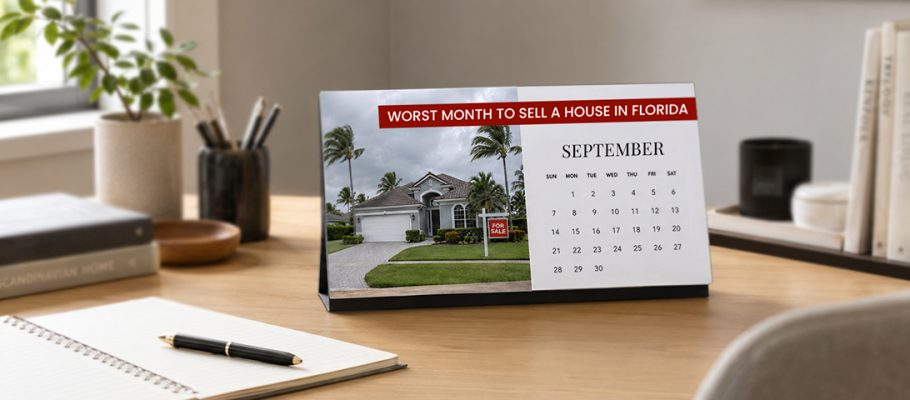
Florida’s slowest months to sell a house are August and September, when hurricane season, back-to-school moves, and intense heat combine to push median days on market above 85. December, despite its reputation, isn’t one of the worst months: Florida homes sold faster in December than in August, September, or October.
Wondering if you picked the wrong month to sell your Florida home? A slower season can make things feel uncertain, but it does not mean your house will not sell.
You will see plenty of articles name one month as the absolute worst, but Florida’s market is not that simple. In this guide, we’ll look at which months can be tougher for sellers, what is behind the slowdown, and whether waiting for a better time actually makes sense for you.
Key Takeaways
Here’s a summary, so you can go straight to what matters most for your situation.
- Florida’s slowest months to sell are August and September, not November or December like many sources claim
- Florida homes took a median of 87 days to sell in August 2025 and 88 days in September 2025, the two slowest months in a 12-month window
- December ranked 8th out of 12 months, faster than October, January, August, and September
- Hurricane season (June 1–November 30) and back-to-school timing drive the August–September slowdown
- Waiting to avoid August or September has a real cost: carrying costs can outweigh any benefit from waiting
Worst Month to Sell a House in Florida Overview
| Rank | Month | Median Days to Sell | New Listings |
|---|---|---|---|
| 1 | March 2026 | 72 | 46,208 |
| 2 | April 2026 | 74 | 44,494 |
| 3 | May 2026 | 75 | 42,776 |
| 4 | June 2026 | 78 | 41,664 |
| 5 | July 2026 | 80 | 39,044 |
| 6 | November 2025 | 81 | 39,856 |
| 7 | February 2026 | 82 | 46,000 |
| 8 | December 2025 | 83 | 32,464 |
| 9 | October 2025 | 85 | 40,724 |
| 10 | January 2026 | 86 | 47,492 |
| 11 | August 2025 | 87 | 37,564 |
| 12 | September 2025 | 88 | 37,692 |
Source: Realtor.com Housing Inventory Core Metrics, via FRED, Federal Reserve Bank of St. Louis.
New listings reflect homes entering the market that month, not total competition. August and September show fewer new listings partly because homes from prior months are taking longer to sell and staying listed longer, not because fewer sellers are trying to sell.
When Is the Worst Time to Sell a House
The worst time to sell in Florida is late summer, specifically August and September, when hurricane season peaks and days on market are longest. Florida homes took a median of 87 to 88 days to sell in those two months. December, often blamed for being slow, actually outperforms both October and January.
Let’s look at what the numbers actually show for each commonly cited month, then unpack why “worst” means different things to different sellers.
Worst Time to Sell a House in Florida: What the Data Shows
What does the national data show, and does it line up with what we just saw in Florida?
ATTOM’s April 2026 analysis looked at more than 52 million single-family home and condo sales from 2015 through 2025. Nationally, October came in as the weakest month, with homes selling for an average 7.9% premium above estimated market value. September was close behind at 8.0%, followed by November at 8.3%.
August is the interesting one. Nationally, it landed closer to the middle of the pack at 8.4%, even though August and September are tied as Florida’s slowest months by days on market. That does not mean the data conflicts. It just shows that sale price and selling speed are two different ways to measure the market.
December is a good example of why the “worst month” idea can be misleading. Nationally, homes sold for an average 9.1% premium in December, which was higher than November, July, or August. Selling around the holidays does not automatically put you at a disadvantage.
Florida can still behave a little differently. Inventory often builds in early fall, which gives buyers more homes to choose from and more room to negotiate. In markets such as Miami and Tampa, late fall can sometimes bring better deals for buyers. That does not necessarily mean buyers have disappeared. It may simply mean sellers are competing with more listings at the same time.
Why There Is No Single Worst Month for Every Florida Seller
There is no single definition of the “worst month” to sell, because real estate is not black-and-white. The “worst month” to sell could mean fewer buyers at open houses, a home that sits longer before it sells, less room to negotiate, or storms getting in the way of showings and closings. Those aren’t always the same month! By the clearest single measure available “how long a home actually sits on the market”- Florida’s answer is genuinely August and September. But other measures, like national pricing data, don’t always point to the exact same months. That is why one simple headline, “worst month” to sell, cannot tell the whole story.

Why Some Months Are Harder to Sell a House in Florida
Some months are harder for Florida sellers because of factors outside their control: hurricane season disrupts showings and closings from June through November, and back-to-school schedules pull family buyers out of the market through August. The holidays get blamed too, but as you’ll see, that reputation doesn’t hold up nearly as well as the other two. None of this means your home won’t sell, just that some months take more effort than others.
Hurricane Season and Weather Disruptions
Hurricane season runs June 1 through November 30, and that’s six months, not one. Here’s what that stretch actually looks like for a seller:
Storm Anxiety
Some buyers hesitate to tour or commit to a home when storms are in the forecast, especially out-of-state buyers unfamiliar with Florida’s rhythms.
Intense Heat and Humidity
Scorching late-summer weather makes open houses and property viewings uncomfortable.
Insurance and Due Diligence Delays
Buyers frequently delay offers in the fall to verify flood zones, windstorm coverage, and escalating homeowner insurance costs.
We’re not going to walk through every way a storm can delay an inspection or a closing here, but if you are wondering about other factors that can affect when you should sell, we’ve covered that in detail in our companion guide, Best Time to Sell a House in Florida. If any of that gives you pause about listing right now, hold that thought. It matters more once we get into whether waiting actually makes sense for your situation.
Back-to-School Slowdown, and the Holiday Myth
School schedules are a big part of what happens in August. Families with school-age children often try to move before classes start, so the number of buyers can drop once the school year is underway.
The holidays are a little different. December actually moves faster than October, January, August, or September by median days on market, and it has the lowest share of price reductions all year. There may be fewer people casually shopping, but the buyers who are still looking tend to be more serious.
Fewer Buyers and More Competition for Their Attention
When fewer buyers are looking, as often happens heading into August, each listing has to work a little harder for attention. Buyers can afford to be pickier, and more homes are competing for the same group of people.
That is what usually makes a slower month feel slower. Your house has not suddenly become harder to sell, there are just fewer active buyers to go around. In August and September, pricing the home well and making a strong first impression can matter even more.
Is September, November or December the Worst Month to Sell?
Of these three, only September genuinely lives up to its reputation, and it shares that distinction with August, which isn’t even in this question but arguably should be. November and December, despite their reputation, don’t hold up against Florida’s own data. Here’s what each month actually looks like on its own terms.
September: Hurricane and School-Year Challenges
I would like to start by noting that September does not slow down on its own. The shift usually starts in August, when the school year begins and fewer families are looking to move.
Then September adds another factor: peak hurricane season. NOAA says Atlantic storm activity has historically peaked around September 10. You can see that slowdown in Florida’s numbers too. Homes spent a median of 87 days on the market in August 2025 and 88 days in September, making them the two slowest months of the year statewide.
November and December: Holiday Slowdowns
November and December often get blamed for a holiday slowdown. That makes sense on the surface, since many families are busy with travel, gatherings, and end-of-year plans instead of house hunting.
But the numbers are more interesting than that. Homes actually sell faster in November and December than they do in August, September, or October. December also has the lowest share of price-reduced listings all year, at just 21.8%, compared with roughly 30% to 33% in many other months.
In other words, sellers who list during the holidays are not cutting prices more often. They are actually doing it less.
Is Now a Bad Time to Sell a House
Nationally, sellers are outnumbering buyers by the widest margin in over a decade, and Florida homes are taking longer to sell than almost any other state’s. That doesn’t mean it’s a bad time to sell; it means buyers who are actively looking are serious, and pricing and presentation matter more than they did a few years ago.
Is It Hard to Sell a House in Florida Now?
Yes, at least by the numbers. As of July 2026, Florida homes are taking a median of 80 days to sell, tied with Hawaii for the longest of any state in the country. Listings are down, price cuts are common, and nationally, active buyers just hit their lowest point in over a decade.
Florida Seller Market Snapshot
| Metric | Value | Year-over-Year |
|---|---|---|
| Median days on market | 80 days | -6.4% |
| Median listing price | $419,000 | -3.7% |
| Active listings | 150,062 | -14.1% |
| New listings | 39,044 | +2.1% |
| Price-reduced listings | 19.4% of active listings | — |
| Pending listings | 45,816 | +7.3% |
Source: Realtor.com Housing Inventory Core Metrics, https://www.realtor.com/research/data/
Think of Florida’s housing market like the tide. Every spring, right around March, it pulls back, homes move fast, buyers are plentiful, and sellers have the upper hand. As summer heats up, the tide slowly comes back in. By August and September, it’s at its highest; homes take longer to sell, and sellers have to work harder for the same result.
This rhythm has repeated itself almost every year for nearly a decade. Markets shift, rates rise and fall, but that underlying tide keeps moving the same way, in and out, spring to fall.
There’s one year worth remembering, though: 2021. That spring, homes were selling in barely over a month, practically year-round, no slow season in sight. Florida was in the middle of a housing shortage so severe that even August and September looked fast. The seasonal pattern didn’t disappear; it just got drowned out by a much bigger force: there simply weren’t enough homes for sale.
Before trusting the tide on its own, check what’s happening with mortgage rates and inventory. Those bigger currents can override the tide entirely, at least for a season or two.
Nationally, the picture explains part of what’s happening locally too. Active home buyers hit a 13-year low in July 2026, and mortgage rates sitting at 6.67 percent are keeping a lot of would-be buyers on the sidelines. That national pullback is part of why Florida’s own numbers above look the way they do.
Should You Wait for a Better Month to Sell?
Knowing August and September tend to be tougher doesn’t automatically mean you should wait for a different one. We built a full six-question framework for working through this exact decision in our Best Time to Sell a House in Florida guide, worth running through if you haven’t already. If waiting simply isn’t an option for you, our team can help you sell your home fast, for cash, regardless of what month it is. Here, we’ll focus on the math that matters most when the reason you’re waiting is specifically to dodge a slower month.
Compare the Potential Benefit With the Cost of Waiting
Waiting for a better month only makes sense if the potential upside is worth the extra cost. In the meantime, the bills do not stop. You are still paying the mortgage, HOA dues, utilities, and basic upkeep for every month you hold onto the house.
Example: a $275,000 Winter Haven home
| Monthly Cash Outflow | Amount |
|---|---|
| Mortgage payment (principal, interest, taxes and insurance in escrow) | $1,850 |
| HOA dues | $150 |
| Electric (keeping the AC running to prevent humidity damage) | $165 |
| Water and sewer | $35 |
| Basic upkeep (lawn care, pest control, minor repairs) | $125 |
| Total monthly cash outflow | $2,325 |
| Cost of waiting 2 months (skipping August and September to list in October) | $4,650 |
That figure includes keeping the electricity running; letting the AC sit off in Florida humidity for weeks can invite mold and moisture damage fast, which isn’t a cost worth cutting even on a vacant listing.
That $4,250 needs to be weighed against what you’d actually gain by skipping straight to October. Based on Florida’s own numbers earlier in this article, October isn’t dramatically faster than September, 85 days versus 88. You’re spending real money to sidestep a three-day difference. With Lincoln Madison Investments, you skip that math entirely: we buy homes as-is, for cash, and can close in as little as days, no waiting on any month at all. If avoiding August or September sounds appealing, selling your home fast, for cash might be a simpler path than waiting it out.
Should You Wait?
Our Best Time to Sell a House in Florida guide covers the full range of reasons waiting can make sense, everything from wanting to finish repairs to holding onto a low mortgage rate. Here, the question is narrower: is waiting actually about avoiding August or September specifically, or is it about something else entirely?
If you are thinking about waiting just to avoid a slower month, look at your local market first. In Lakeland, homes spent a median of 63 days on the market in June 2026, much faster than the 87 to 88 days we saw statewide in August and September 2025.
That is a good reminder that Florida-wide trends do not always match what is happening in your city. If homes in your part of Polk County are still moving at a reasonable pace and you can afford the carrying costs, waiting for a supposedly better month may not make much difference.
Should You Sell Now?
Ask yourself this: are you actually waiting for something specific, or just waiting out a month you’ve heard is bad? Our Best Time to Sell a House in Florida guide covers the real reasons selling now tends to win, vacant properties, inherited homes, and foreclosure deadlines. If none of those describe you, and it’s purely the calendar giving you pause, that’s usually not worth the carrying costs of sitting still. A fast, as-is cash sale means you don’t have to outlast August or September at all.

How to Sell a House During a Difficult Month
Selling during a slower month comes down to three things: price to match current conditions, know what else is competing for the same buyers, and stay flexible on showings and closing dates. None of it requires waiting for a better month, just adjusting your approach for the one you’re in.
Here’s how each step works in practice.
Step 1: Price for Current Market Conditions
Start with homes that actually sold, not just homes that are still listed. A good comparative market analysis usually looks at 3 to 5 nearby homes that are similar in size, condition, and location and sold within the last 60 to 90 days. Active listings only show what sellers are asking. Sold homes show what buyers were willing to pay.
From there, account for the differences. A renovated kitchen, an extra bathroom, or a larger lot can all affect value. You can also compare the price per square foot as a quick reality check. Florida’s statewide median is around $252 per square foot, but your city or county numbers will usually be more useful.
Inventory matters too. If months of supply are running high, like Polk County’s current 4.71 months, it may be smarter to price a little more competitively from the beginning. Starting too high and cutting the price later can cost you valuable time, especially in a slower market.
Step 2: Watch Your Local Competition
Look at what’s actively listed within a mile or two of your home right now, not just what sold recently. If three other similar homes are sitting on the market alongside yours, buyers are cross-shopping all four, and whichever one looks best, in photos, in condition, at its price point, gets the showing requests.
Pay attention to what those competing listings are doing differently too. If they’ve all had a recent price drop, that’s a signal the market’s telling you something before you have to find out the hard way. If your home has something they don’t- a bigger yard, a newer roof, an updated kitchen- make sure that’s the first thing a buyer sees, not something buried in the listing description.
Stay Flexible With Showings and Closing Dates
The fewer buyers are shopping, the more each one matters. Say yes to showings outside normal hours, respond quickly to questions, and build some flexibility into your closing timeline, especially during hurricane season, when a storm can shift someone’s schedule with little notice.
Common Mistakes When Selling During a Slow Month
A slow month can tempt sellers into some very fixable mistakes. Here’s what to watch for:
- Panicking and dropping the price too fast, before giving a fair asking price real time to work
- Assuming a listing photo taken in any daylight is good enough, when buyers are scrolling from home and deciding in seconds
- Believing December is automatically bad, and delaying a sale that could have closed just fine, based on data we’ve already walked through
- Skipping basic prep, decluttering, a deep clean, minor repairs, because it’s a slow month anyway
- Withdrawing and relisting the property to make it look “new” again. It’s a common instinct when a listing feels stale, but experienced buyers and agents can often see a property’s full history, and a suspicious relisting pattern can raise more questions than it solves.
- Being slow to respond to showing requests or questions, since the buyers still looking during a slow month tend to be serious, and they won’t wait around
None of these mistakes are fatal on their own. But stacked together, they can turn a genuinely slower month into a much longer one.
Worst Month to Sell a House in Florida FAQs
Here are some questions homeowners usually have about timing a sale.
What Is the Hardest Month to Sell a House?
By Florida’s own days-on-market data, September is the hardest month statewide, with August close behind. Nationally, ATTOM’s data points to October instead, since that data measures price premium, not speed, a different metric entirely.
Is December a Bad Month to Sell a House in Florida?
No. December actually ranks 8th of 12 months by days on market, faster than October, January, August, and September, and it has the lowest share of price-reduced listings of the entire year.
Is September a Bad Month to Sell a House in Florida?
Yes, by the numbers. September is Florida’s slowest month, tied closely with August, driven by hurricane season’s peak activity and the tail end of back-to-school moves pulling family buyers out of the market.
Is It Better to Sell Now or Wait Until Spring?
It depends on your carrying costs and your deadline. If you can comfortably afford to wait and have no pressing timeline, spring’s stronger buyer activity may net a better outcome. If waiting adds real financial strain, selling now is often the smarter move.
Can You Still Get a Good Price During a Slow Month?
Yes. A slower month means fewer buyers, not none, and the ones still looking tend to be serious. A well-priced, well-presented home can still sell for a fair price even in August or September.
What If I Need to Sell Before a Better Season?
You don’t have to wait for a stronger season to sell. If a deadline or financial pressure is pushing you toward a faster timeline, selling your home fast, for cash can close in days instead of months, regardless of the month.
Conclusion
There’s no single worst month to sell a house in Florida, but the data do point to two months in particular: August and September are genuinely the toughest, driven by hurricane season and back-to-school timing, while December’s reputation doesn’t hold up against the numbers.
Just remember, at the end, what matters most is your own situation: your deadline, your carrying costs, and your home’s condition, not just what the calendar says.
Are you struggling to sell your home?
If you’re trying to decide whether to wait or sell now, Lincoln Madison Investments can help you weigh your options. With more than 15 years of experience buying homes across Polk County, we buy houses in any condition and at any time of year.
Let’s talk about your property; we are here to help. Call 863-521-0549 to speak to one of our experienced agents or request a no-obligation cash offer today.
References
- ATTOM Data Solutions, 2026 Best Days to Sell a Home, https://www.attomdata.com/news/market-trends/home-sales-prices/2026-best-days-to-sell-a-home/
- Realtor.com, Housing Inventory Core Metrics, State Data, https://www.realtor.com/research/data/
- Realtor.com, Housing Inventory: Median Days on Market in Florida, retrieved via FRED, Federal Reserve Bank of St. Louis, https://fred.stlouisfed.org/series/MEDDAYONMARFL
- Realtor.com, Housing Inventory: New Listing Count in Florida, retrieved via FRED, Federal Reserve Bank of St. Louis, https://fred.stlouisfed.org/series/NEWLISCOUFL
- Realtor.com, Housing Inventory: Price Reduced Count in Florida and Active Listing Count in Florida, retrieved via FRED, Federal Reserve Bank of St. Louis, https://fred.stlouisfed.org/series/PRIREDCOUFL and https://fred.stlouisfed.org/series/ACTLISCOUFL
- National Hurricane Center, NOAA, Tropical Cyclone Climatology, https://www.nhc.noaa.gov/climo/
- Florida Realtors, Florida Buyers See Late Fall Advantage, https://www.floridarealtors.org/news-media/news-articles/2025/09/florida-buyers-see-late-fall-advantage